Before you buy
The building report will record that a wall reads wet. It will rarely tell you what is causing it, and in Adelaide that gap can be tens of thousands of dollars.
A building inspection is a snapshot by a generalist. It is good at noting moisture; it is not usually written to distinguish an absent damp course from a cracked one, or either from a bridged one. Rising Damp Adelaide arranges damp assessments during the cooling-off period, which is when the answer is worth the most to you.
Stand outside and compare the path, paving or soil against where the floor sits inside. Higher outside is a finding, and you need no equipment to see it.
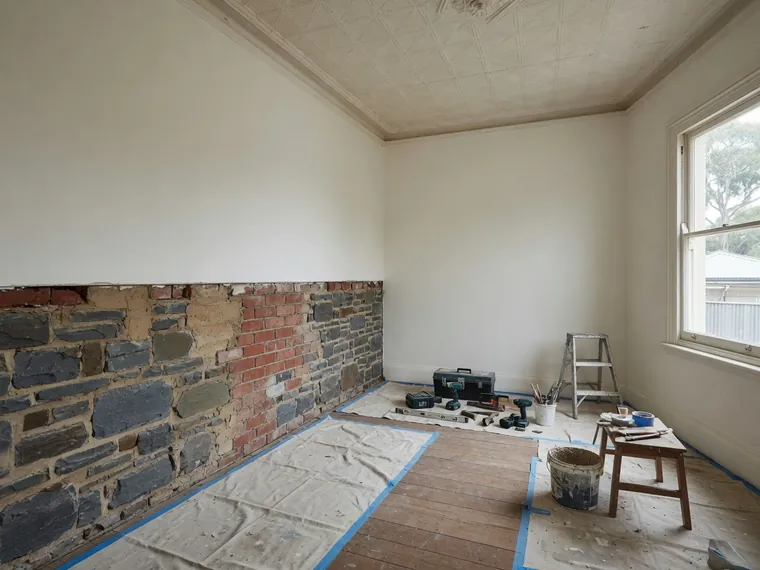
On bluestone this is the single most informative ten seconds available to you. Mortar that comes away as powder at the base of the wall has been wet for years.
On sandstone, joints standing forward of a dished stone face means fretting. That is the expensive one.
Especially a single wall painted more recently than the rest of the room. Sometimes innocent. Always worth asking about.
Cement render carried down over the base of an old wall, drumming hollow when tapped, is frequently hiding rather than solving.
Vendors ventilate before an open inspection. Ask to see the house at a time it has been shut up.
Two things. First, the age of the stone stock means a genuine absence of any damp course is common, and an absent course is a bigger job than a bridged one. Second, the reactive clay means that on interwar brick a cracked course is likelier than no course — so the building report saying "no evidence of a damp proof course" is worth challenging rather than accepting. Those two facts point at quite different numbers.
South Australian contracts allow a short cooling-off period, and a damp assessment fits inside it if you organise it immediately rather than at the end. What you want in writing is the cause, the extent and an indicative cost — enough to proceed with confidence, to renegotiate, or to walk. Send us the address and the date your period ends and we will tell you honestly whether it can be done in time.
The oldest stone stock sits in the inner ring and along the coast, and that is where most of the calls come from.
Tell us what the wall is doing. We will arrange someone to meter it and put the cause in writing.