Sandstone and freestone
The expensive failure, and the one that tells you the problem has been running for years rather than months.
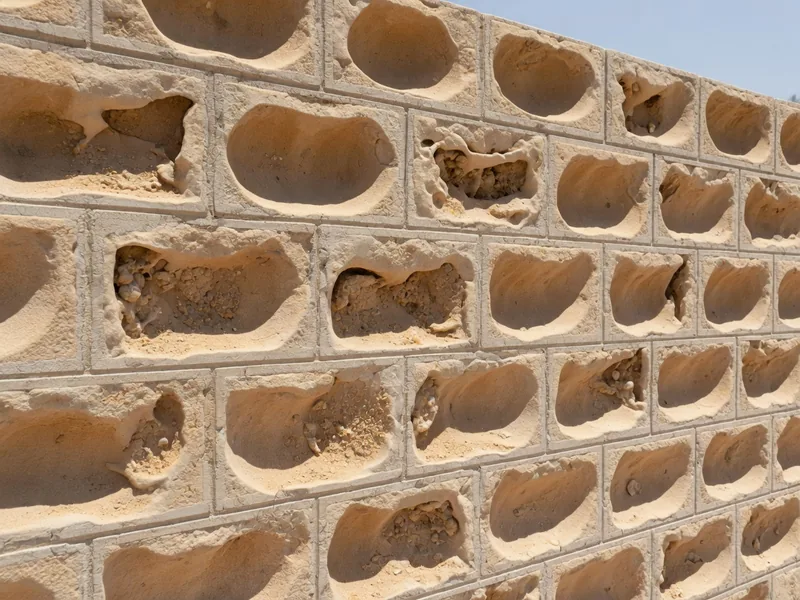
Sandstone behaves in the opposite way to bluestone. It is porous, so it takes water and dissolved salt into the body of the stone rather than confining them to the joints. When the salt crystallises it does so inside the stone's own pore structure, and the face of the block begins to break down. Rising Damp Adelaide sees this most often through Hyde Park, Goodwood and the older parts of Norwood.
The tell is the relationship between stone and mortar. On a fretting wall the mortar joints stand proud while the stone between them has dished, hollowed and powdered back. That is the wrong way round for any healthy wall, and it is unmistakable once you have seen it. Early on it reads as a slightly sandy surface that marks your hand. Later the blocks are visibly cupped and shedding material onto the ground below.
Stone that has fretted is gone. Nothing puts it back. The realistic options are to arrest the process by removing the water source and letting the salt come out, to repair individual blocks by indenting new stone where the loss is structural or unsightly, or to accept the weathered appearance where it is neither. All three begin with the same step: stop feeding it.
Water-repellent coatings sound exactly right and are usually wrong. They trap moisture and salt behind the treated face, so the failure moves a few millimetres deeper and returns.
Same mechanism as cement pointing on bluestone. The wall cannot breathe through the render, so it breathes through whatever is above it, and the damage relocates upward.
Removes the weathered outer skin, which on old sandstone is often the most durable part. It exposes softer material and accelerates everything.
Each further wet-dry cycle adds salt. Time is not neutral on a fretting wall the way it is on a stable one.
Where stone is worth preserving, salt can be drawn out of it with a clay or cellulose poultice applied to the face and allowed to dry. It is slow, it is done in cycles, and it is a conservation technique rather than a routine part of a damp job. It is worth knowing it exists so that you recognise it when a heritage property genuinely calls for it — and recognise when it is being sold to a house that does not.
The oldest stone stock sits in the inner ring and along the coast, and that is where most of the calls come from.
Tell us what the wall is doing. We will arrange someone to meter it and put the cause in writing.