Ground movement
In most cities the question is whether a house has a damp course. On Adelaide's clay the more useful question is whether it still works.
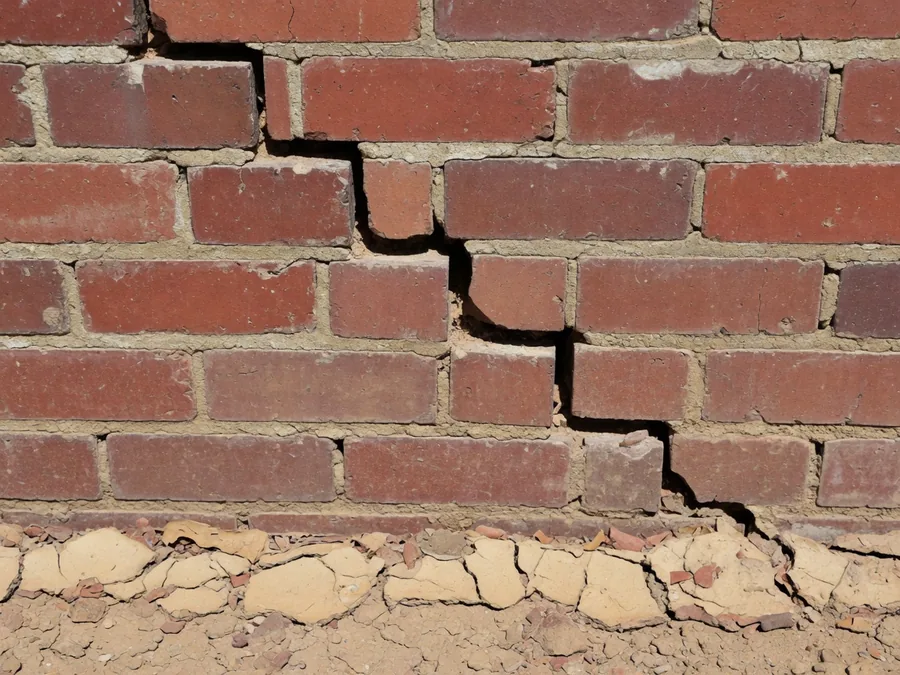
Adelaide sits on some of the most reactive soil of any Australian capital. Clay swells when wet and shrinks when dry, and the local climate — a wet winter, then a genuinely hot dry summer — drives that cycle hard every year. Rising Damp Adelaide treats this as a standard part of an Adelaide assessment rather than an unusual finding.
A slate damp course is durable but brittle. A bituminous one is more forgiving but can tear. Both are laid as a continuous horizontal barrier, and both depend on staying continuous. Seasonal heave and settlement flex the wall above them, and over decades that produces cracks, steps and separations in a barrier that was entirely sound when it was built.
The practical consequence is that on a 1910s to 1930s brick bungalow in Prospect or Goodwood, a cracked damp course is a more likely explanation than no damp course. That changes the diagnosis and it changes the repair.
A cracked course leaks where it is cracked. Damp that appears in sections along a wall rather than evenly across it is a hint.
Cracks that open in summer and close in winter are movement, not structural failure. Owners often notice doors sticking at the same time.
A wall dry for eighty years that starts showing damp is more likely to have had something change — the course, the drainage next door, or the ground — than to have slowly developed the problem.
A mature tree draws a great deal of water from clay in summer, increasing local shrinkage. Removing one can be as disruptive as planting one.
Where movement is part of the picture, a chemical injected course has an advantage over a physical one: it forms within the wall's own pore structure rather than as a rigid inserted layer, so it tolerates flex better. It does not make the movement stop, and it does not address any structural consequences, which are a different trade's problem. What matters is that the assessment identifies movement as a factor rather than treating a cracked course as an absent one — because the repairs are not the same and neither are the prices.
The oldest stone stock sits in the inner ring and along the coast, and that is where most of the calls come from.
Tell us what the wall is doing. We will arrange someone to meter it and put the cause in writing.